

"1993, round trip: pop and pochangmacha"
(By Martin Petersen)
BTS. Parasite. Squid Game.
Over the past decade, Korean popular culture has achieved global impact — through music, film, and TV. Behind these global successes lies a broader, visually rich cultural landscape that encompasses historical dramas, urban food culture, feminist literature, and a vividly coloured world of comics (manhwa).
A decisive turning point for the visibility of Korean culture on the global stage came with the 1988 Seoul Olympics. The Olympics were more than a sporting event; the event reshaped the capital with new infrastructure, modern stadiums, and cultural facilities, all designed to present South Korea as a progressive nation. At the same time, traditions that might be considered controversial abroad, such as dishes made with dog meat, were temporarily suspended. The cheerful-looking tiger mascot Hodori became a symbol of national identity, reaching out to the world as a traditional emblem of strength, courage, and national pride in Korean folklore and art. For many Koreans, especially the younger generation, the event represented an encounter with the world.
Today, Korean popular culture has developed into a dynamic field of expression that reflects the complexity of modern Korean society, and with stories that often don't hesitate to challenge nationalist narratives.
Recurring themes emerge across the media: History and national identity are central in historical drama series (sageuk) and historically inspired films, which often reinterpret Korea's dynastic past with emotional intensity, stylish, glamorous, and heavily romanticized scenes — but also, as in the case of Kingdom, with sharp social commentary. Taken together, the historical narratives have also helped make Seoul's cultural heritage sites popular tourist destinations.
Class differences and social inequality are also explored in global successes like Squid Game and Parasite, which depict the barriers between rich and poor. Street life and everyday spaces, such as pojangmacha (tent restaurants), recur as settings for both emotional release and social observation — places where private and public flow together. As, for example, in the national success Reply 1988, which unfolds a story of the recent past in a working- and lower-middle-class neighbourhood in Seoul.
Gender and relationships are also recurring themes across media and genres. Idealized romance remains a cornerstone of drama series and entertainment programmes, and is valued globally for its soft, family-oriented yet playful portrayals of couples, as in Crash Landing on You. At the same time, contemporary literature and independent film offer more critical perspectives on relationships, social pressure, and gender roles. A feminist current runs through today's Korean literature in translation, with authors such as Han Kang, known for The Vegetarian, and Cho Nam-joo, whose Kim Jiyoung, Born 1982 became a cultural landmark work confronting patriarchy, inequality, and the emotional consequences of societal expectations.
At the same time, K-pop has developed into a cultural phenomenon with global appeal. By seamlessly blending the Korean language, fashion, and choreography with international music genres, K-pop creates a tightly curated visual universe centred on talents and idols. Long before the international K-pop boom, artists like Kim Gun-mo and Seo Taiji were already transforming Korea's sonic and cultural landscape — blending Western styles with local sensibilities to speak to a new urban generation.
Visual storytelling has also played a central role in Korean culture. The emergence of webtoons (online comics) in the early 2000s introduced new ways of combining personal reflection with social observation — often with a down-to-earth, true-to-life realism. This ethnographic quality is brought into the present project by the South Korean comics creator Jeon Nak-joo, whose work bridges popular aesthetics and lived reality.
The project also includes two Danish illustrators: Thit Bitsch, an independent artist here with a distinct visual style centred on diary-style storytelling, and Rasmus Meisler, a documentary illustrator with experience in visual reportage for newspapers and magazines. Together, the three illustrators offer different perspectives on Korean popular culture — where ethnographic attention, artistic interpretation, and documentary observation merge.
The essay below, with illustrations by Jeon Nak-joo, is a personal greeting to 1993. The year I myself first came to South Korea.
Illustration: Rasmus Meisler
Illustrations: Jeon Nak-joo
Illustration: Thit Bitsch
Illustration 1
Illustration 1 – Pojangmacha: evening cosiness under plastic tarpaulins
A glowing orange pojangmacha in the evening dark — a familiar sight in Korea's urban spaces. These small, tent-like street bars serve simple food and drink late into the night and offer comfort to a broad spectrum of customers: tired office workers on their way home, friends drinking hard, or couples on a more casual date.
Often no bigger than a couple of tables, pojangmacha evoke feelings of nostalgia and intimacy despite the cramped quarters. Popular drama series like Reply 1988 have portrayed them as beloved neighbourhood hangouts; places where big life decisions, romantic confessions, and warm friendships unfold over steaming plates and soju. At the same time, pojangmacha also have a reputation for being noisy, unregulated, and at times called into question over hygiene — especially in big cities trying to modernize their image.
The food is part of their charm: spicy tteokbokki (rice cakes), odeng (fish cakes in broth), grilled skewers, and warm bowls of ramyeon are among the favourites. Simple, accessible, and wrapped in plastic against the cold, pojangmacha remain a beloved part of Korea's urban nightscape — a place where the boundaries between private and public life blur for a while.
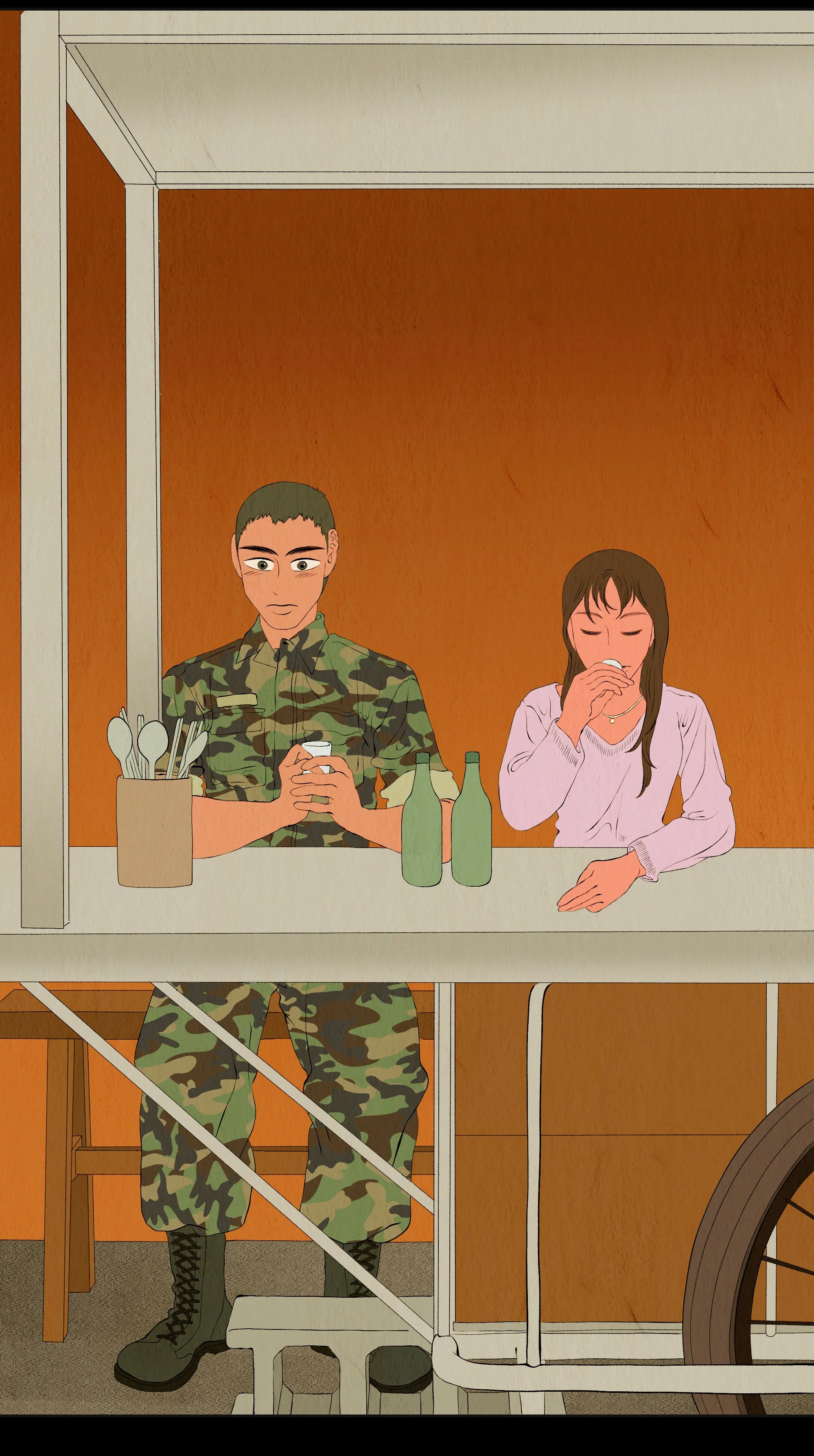
Illustration 2
Illustration 2 – At first glance; with lowered eyes
A young couple sits in a pojangmacha. Their eyes meet briefly before they look down in shared shyness. The young man is home in Seoul on short leave from the military and is being welcomed by his girlfriend. In Korean dating culture — especially in public spaces — expressions of emotion are subtle and shaped by norms of modesty and restraint. This quiet moment echoes scenes from drama series like Reply 1988, where romance buds slowly through hesitant glances and eloquent silences.
This emotional restraint also has musical echoes — audible in Kim Gun-mo's early ballads like "Excuse" (핑계, 1993), which captures the uncertainty and longing of young love in the early years of modern Korean pop.
Illustration 3
Illustration 4
Illustration 3/4 – A shared drink, an open invitation
He pours her a glass of soju, and she returns the gesture — small acts filled with meaning. Sharing alcohol in an intimate setting like a pojangmacha is both a romantic ritual and a form of social bonding, where mutual care and respect are expressed without words. In countless Korean drama series, such roadside moments create room for connection beyond the formalities of everyday life.
Extending this emotional intimacy, Seo Taiji and Boys' 1990s hit "To You" (너에게) introduced a new kind of openness — modern, reflective, and deeply personal — which helped change how young Koreans expressed vulnerability both in public and through music.
Illustration 5
Illustration 5 – A held hand, a bold step
He gently reaches out for her hand. In Korean drama series, this simple gesture often marks a turning point — a physical confirmation of emotional development. Series build whole episodes around such understated moments.
Here too, the influence of early K-pop can be felt: Kim Gun-mo's "Beautiful Farewell" (아름다운 이별, 1995) transforms quiet gestures and held-back feelings into powerful musical moments that resonated deeply with a generation who would have to navigate love in a time of rapid change.
Illustration 6
Illustration 6 – Averted glances, inner storms
She turns her gaze away, again with lowered eyes. In Korean romantic culture, this kind of hesitation is part of an emotional choreography — where even retreat can carry meaning. Drama series explore this inner tension: desire held back by timing, fear, or social expectations. In Seo Taiji's music, especially "Come Back Home" (컴백홈, 1995), the longing is channelled through beats and lyrics that reflect the emotional complexity of young people caught between tradition and rebellion.
Illustration 7
Illustration 7 – Hovering lips, eternal moments
The couple's lips — hovering, but without touching. In K-dramas, this moment of touch-free intimacy is iconic: dramatic, unresolved, and charged with anticipation. Such scenes reflect a culture that values emotional build-up over immediate release.
This ethos is also found in early K-pop, where both Kim Gun-mo and Seo Taiji wove romance and restraint into modern Korean music — creating narratives in which the distance between people was just as meaningful as their closeness.
Illustration 8
Illustration 8 – Soju and stardom: selling spirits, shaping femininity
This illustration reworks a classic Korean soju ad from the early 1990s — a period when alcohol ads were everywhere, and celebrities played a central role in selling not just the drink, but a whole mood. Leading actresses and female singers were often cast with longing looks toward the camera.
The ads projected a particular ideal: a woman who was emotionally restrained and quietly graceful — even while drinking. The femininity on display was carefully calibrated: never too bold, never too carefree. Alcohol was traditionally associated with masculinity and working life. The soju ads of the early '90s thus reinforced conventional gender roles.
The celebrities helped normalize it. Their presence in alcohol ads made soju modern and relatable, while wrapping the drink in longing and soft glamour. Beneath the surface, though, the ads reflected deeper societal expectations: women could now take part in public leisure activities, but conditioned on norms of modesty, beauty, and emotional availability.
Illustration 9
Illustration 9 – Pinggae on cassette: love and longing on loop
A worn cassette tape of Kim Gun-mo's Pinggae (Excuse, 1993) — original or bootleg. In the 1990s, these were sold in shops as well as at market stalls, and formed part of the soundscape that defined Korea's early 1990s.
Pop music was ubiquitous and woven into everyday life through radio, cassette tapes, and entertainment programmes on TV. Pinggae, a ballad steeped in regret and emotional hesitation, gave voice to the confusion of a generation growing up in a society undergoing rapid modernization. With its lyrics about neglected love and belated apologies, the song struck a chord with young Koreans.
Illustration 10
Illustration 10 – I Know, I remember it well
Three boys imitate a scene from Seo Taiji and Boys' groundbreaking music video Nan Arayo (I Know, 1992) — the choreography and energy are instantly recognizable to anyone who remembers the song and the video. Frontman Seo Taiji wasn't just a performer; he set off a cultural shift. With their genre-blending sound — hip-hop, rock, and techno — and emotionally raw lyrics about teenage confusion and identity, Seo Taiji and Boys gave Korean youth new ways to express themselves.
Just as innovative was their style: baggy sweatshirts, ripped jeans, and sneakers inspired by American streetwear, reinterpreted in a distinctly Korean way. These outfits offered an alternative image of youth — cool, defiant, and relatable. In the early 1990s, fans across the country imitated not just the music but also the style, launching a new fashion language based on global inspiration and local interpretation.
As their fame grew, Seo Taiji and Boys became icons in advertising, entertainment programmes, and as representatives of modern Korea.
All etnographic illustrations from this essay are made by artist Jeon Nak-joo.
You can discover more illustrations by Nak-Joo here.