

“1-2-3… cha”
(By Martin Petersen)
Why stop while the going's good? After all, it can (almost) only get good, better, best. That seems to be the thinking behind 1-2-3… cha. Colleagues, business contacts, friends, dates… people brought together for an evening and a night, moving from one place to the next, to the third. And, since they're already well underway, why not juuust one last place… Sound familiar? In Korea it's called 1, 2, 3… cha. First, second, third… round.
Common to nearly every stop on the shared journey into the night is food and drink in an ocean of combinations. No alcohol without food! As evening turns to night, the taste buds are bombarded at the same time as the blood-alcohol levels, the conversations, and the mood all rise. Along the way the scene changes too: restaurant becomes maybe a pub; pub becomes karaoke bar, and who knows, karaoke bar becomes street food stall… For a while, a group of people are brought closer and closer together in a flavour-carousel out of this world, before they say goodbye and hurry through the night to catch the last metro train to the suburbs.
One Friday evening we went on a 1-2-3… cha with Minjae Lee in the Seoul district of Cheongnyangni.
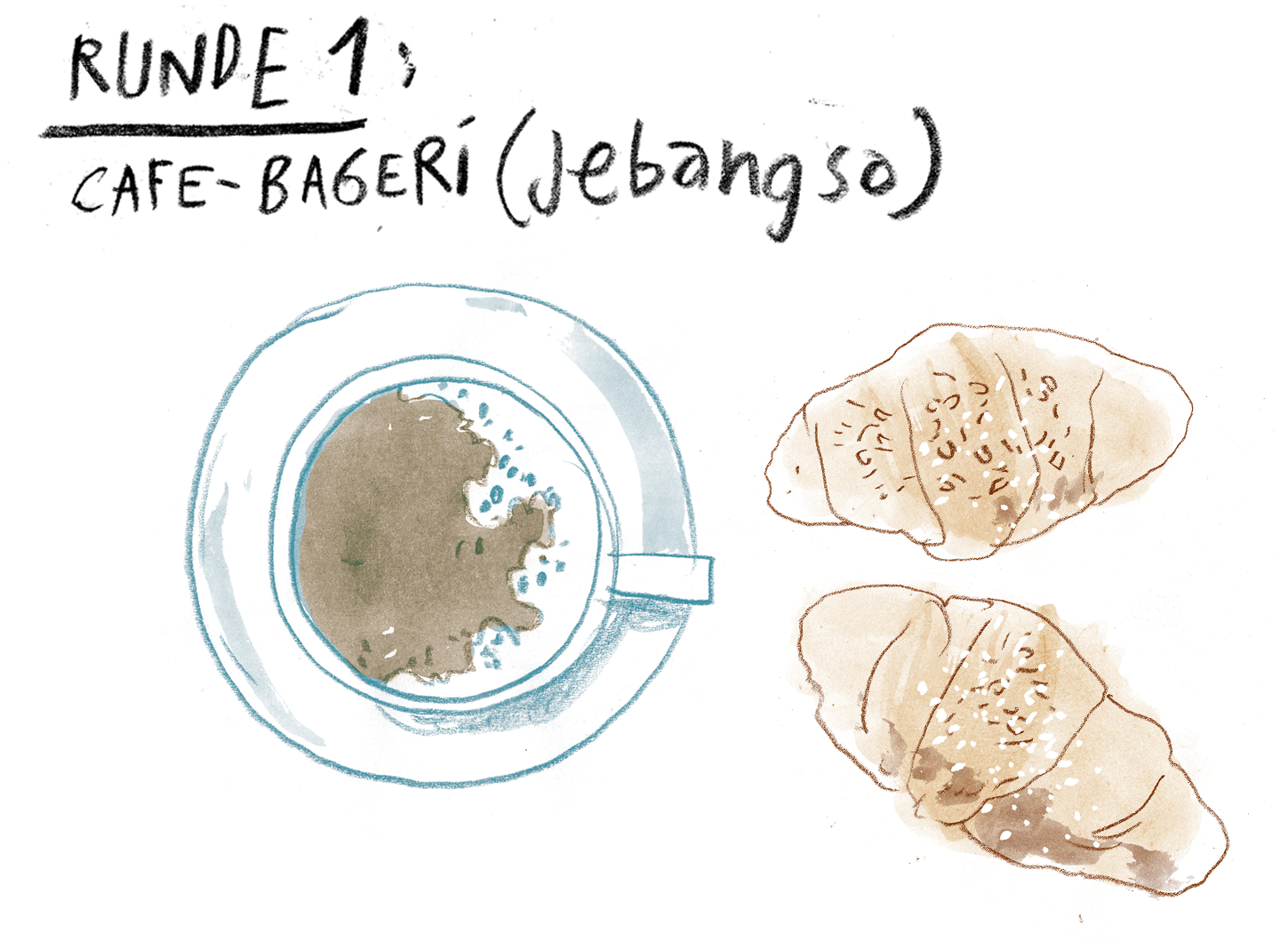
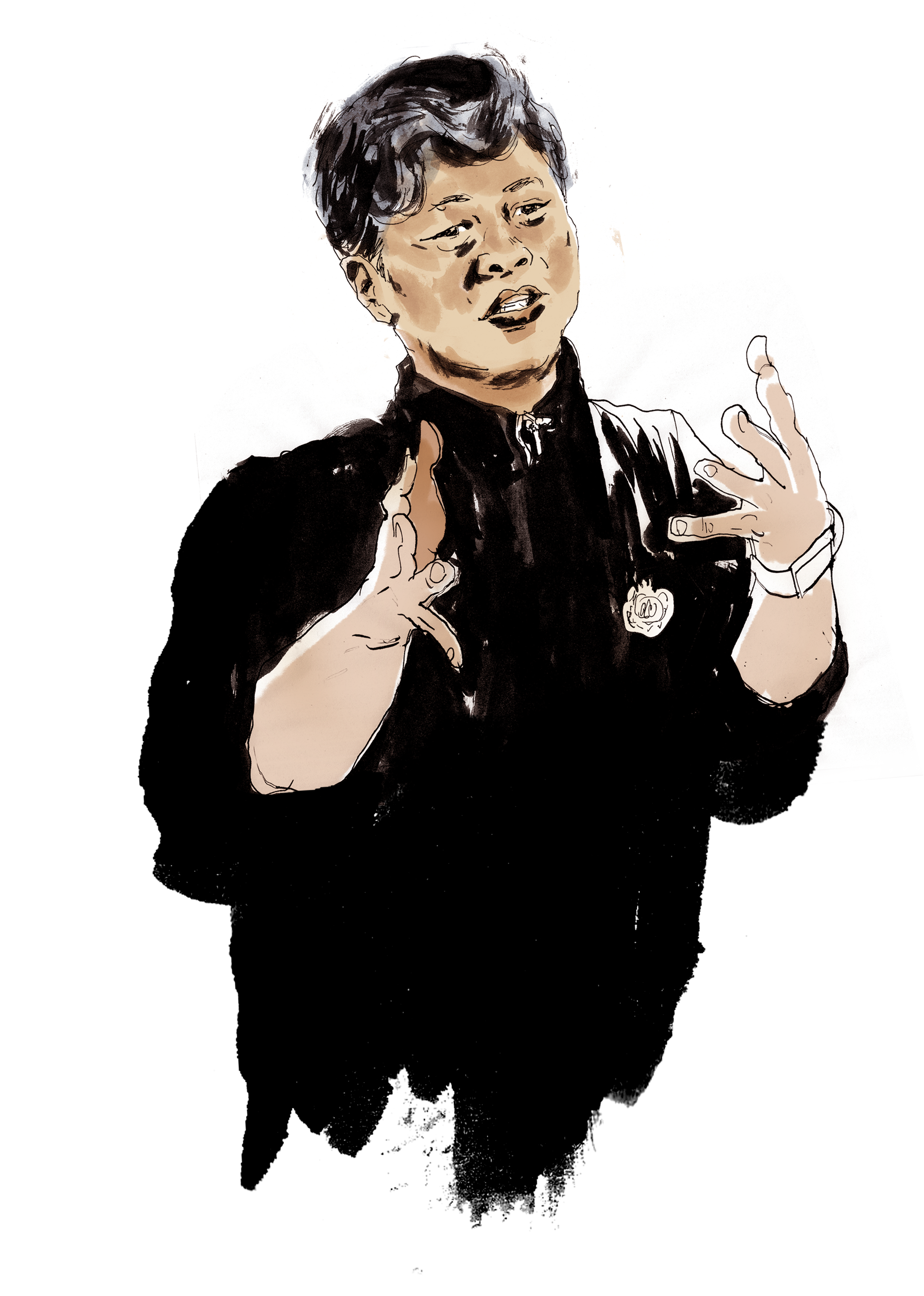
Minjae is a broadly smiling man. His handshake is firm and hard, like a Danish uncle's handshake at family birthdays in the 1980s. It's not a handshake you often get otherwise in Seoul, where a polite bow is still the norm. Minjae is probably the youngest person in the café-bakery. It's mostly larger and smaller groups of middle-aged and older women, who use the café as a meeting place. Bakeries emerged in Seoul as early as the late 1800s with the influx of Japanese merchants, but were predominantly for the elite. After the Korean War (1950–1953), wheat-based food became more widespread as a result of American aid in the form of flour. With that came cheap bread and cakes for the working class. In recent decades, the bakeries have gradually developed into more modern café-bakeries with coffee and sweets, like "The Sweet Bakery." The selection of coffee and refreshments can't begin to keep up with the franchise cafés that serve as workspace and hang-out for students and young people in particular on every street in Seoul. But you can get freshly baked bread and sweet cakes at a good price.
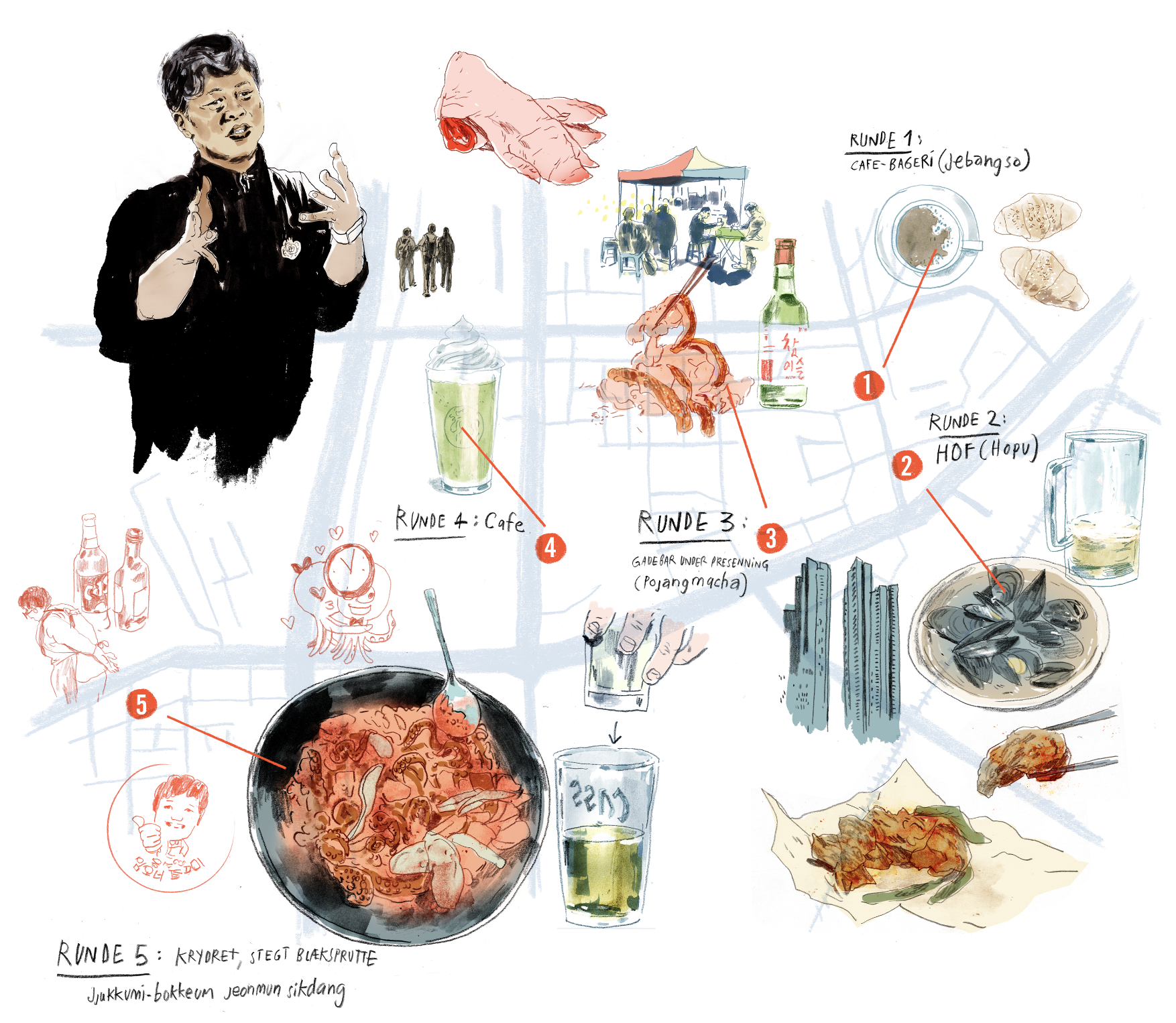
ROUND 1: Café-bakery (제빵소, jebbangso)
We meet Minjae at The Sweet Bakery (달콤제빵소, Dalkom Jeppangso), a busy café-bakery a three-minute walk from Cheongnyangni's newly built train station. The station has a long history as an arrival point for goods and people from eastern Korea. That has left its mark on the district; one of Seoul's largest food markets, Cheongnyangni Market, lies only a few minutes' walk from here.
Minjae introduces us to the area for our 1, 2, 3… cha: "Cheongnyangni is a really authentic, down-to-earth part of Seoul. The area has a huge traditional market and an excellent food street. The district has undergone a transformation, in which the former red-light district, Cheongnyangni 588, was torn down in the process. A large, luxury apartment complex has been built on the site. The district as it looks now is quite different from the Cheongnyangni I first came to know in the early 2000s. The area around the traditional market has, however, been preserved and still has a working-class-neighbourhood feel. Let's get going!" Minjae leads us out of the bakery.
ROUND 2: Hof (호프, hopeu)
"Let's start by going to a 'hopeu,'" says Minjae. It takes him about thirty seconds to find one. Hopeu is a German loanword; it comes from 'Hof' and is a pub. This one is called Sea Snail Land – Cheongnyangni Station, Branch 1 (골뱅이나라 청량리역1호점), named after one of the dishes on the menu.
At a hof in Seoul you can typically get large mugs of cold draught beer along with anju (snacks) and more filling meals like grilled chicken. There's a man standing in the doorway of our hof; swaying is probably a more precise description of his state this late Friday afternoon. He seems to have got a head start on the cold draught beers… and is rather thrilled at the sight of our party. He shouts a welcome that's hard to tell is in Korean or English. His female companion and the female host quickly get him back into his chair and settled down. "I love coming to places like this," Minjae exclaims. He's a food scholar, deeply interested in the working class's food culture in Seoul. "I always find someone to talk to." The place is full of round tables, the walls scrawled with many hundreds of greetings and quick line drawings, photo prints of dishes, and alcohol ads with female models roguishly raising a toast toward us. We sit down at a table and order:
Dish 1: Fried chicken (후라이드 치킨, huraideu chikin): Double-fried, crispy Korean chicken with gochujang (chili paste), sugar, garlic, and syrup. A hof classic.
Dish 2: Mussel soup (홍합탕, honghap-tang): A clear, mild soup with fresh mussels, garlic, and vegetables. Typically served as a 'free' side.
Alcohol: Ice-cold, locally brewed draught beer.
Hof can be traced back to the late 1960s and can be seen as an expression of Seoul's budding growth. A hof is an obvious and relaxed stop on a hoesik (company night out). More work than leisure, hoesik is a setting for loose chat but also for striking deals — working life's hierarchies and its written and unwritten rules are perhaps less visible, but they still apply. Today the hof has been joined by craft beer pubs in Seoul, but the slightly more relaxed settings, like here at Sea Snail Land, are still alive and well. Our hof can probably best be compared to an old-fashioned pub on a slightly quiet day.
ROUND 3: Pojangmacha (포장마차, street restaurant under a tarpaulin)
Evening darkness has fallen. Well warmed up with crispy chicken, cold beers, and mussel soup, we move into the market. It's an enormous, vividly colourful, fragrant place. There are butcher shops with everything from pigs' heads to chicken feet, fishmongers with aquariums tightly packed with fish and shellfish, snack corners, liquor shops, and traditional-medicine shops in row upon row. Many of the shops are already closed for the evening, but there's still plenty of life in the street outside the places that also sell food. We sit down at a street restaurant with red tables and small blue plastic stools under a giant parasol in the same colour combination. The third round is, you see, at a pojangmacha called Fruit & Veg Pocha (청과 포차), named after the fruit-and-veg market right next door.
Pojangmacha translates directly as "cart with a tarpaulin." It's the umbrella term for small, often mobile street restaurants with a fondness for colourful plastic stools. Here people sit shoulder to shoulder eating offal, mussel pancakes, or tteokbokki (rice cakes in chili sauce) and drinking spirits as night falls. Behind the blue-and-red parasol towers the new district, with skyscrapers that have shot up where the shut-down red-light district stood a few years ago. The food market hasn't been urban-renewed and keeps pace with the times at a more sedate tempo.
Minjae grew up with a love of rural life and farming. He got it from his grandparents, who were farmers, and whom he visited every weekend as a child. As a university student, though, he realized that his view of rural life was romantically coloured by his childhood memories. Life in the countryside can also be hard, and often something quite different from the comfortable existence in Seoul. He explores this in his work as a food scholar. In his free time he loves visiting markets and finding dishes and ingredients fresh from Korea's land and sea. It probably also reminds him of childhood meals in the countryside. As Minjae talks, food and drink arrive on the table:
Dish: Jokbal (족발): Pig's trotter slow-cooked in soy sauce, ginger, garlic, onion, rice wine, sugar, and spices. Sliced and often eaten with garlic, chili, and fresh lettuce leaves.
Alcohol: Soju (소주): Korea's most popular spirit; typically 16–20% alcohol. Made from distilled grain, diluted with water. Drunk neat, in shots, or mixed with beer.
The pojangmacha appeared in the 1970s. Here, women sold cheap, hot food and high-proof alcohol from carts covered with tarpaulins. This kind of street kitchen is still a place where the working class can get warm, cheap food and cheerful company after a long working day. Urban renewal, food regulations, and rising prosperity have, however, put pojangmacha culture under pressure in many parts of Seoul. Here at the market, with direct access to good produce from land and sea, it still looks like its old self. Further into the centre, several side streets with 'pocha' have become popular hang-outs for the city's young people.
ROUND 4: Café
It's late in the evening. Minjae takes us further into the food market — here the new skyscrapers can no longer be seen. He leads us through long, covered stretches of street — so-called market arcades — where the stalls are built in under an arched steel roof with skylights of plastic or glass. The aromas are more intense here, but the area is almost empty of people. The market arcade probably doesn't truly wake up again until daybreak, when fresh supplies begin coming in from land and sea. At a small street kitchen, two solitary older men sit hunched over their modest suppers. In a noodle bar, a third older man sits in a French beret, slurping noodles.
But we don't stop at the man with the French beret. Minjae presses on undaunted into steel, neon, and blind corners, and then up a staircase. He opens a door and suddenly, without warning, we're standing in a disused cinema. The change of rhythm couldn't be more abrupt. We've dropped into an icon of Seoul's gentrification: Starbucks Gyeongdong 1960 (스타벅스 경동 1960). A disused cinema from 1960 that reopened its doors in 2022 as a café. The aftertaste of draught beer and soju, pig's trotters and grilled chicken feels utterly out of place here in the cinema hall, which rises high toward the ceiling with columns and staircases. It's like stumbling into a hushed cathedral. We lower our voices entirely automatically, like the many pairs of friends and couples on dates who, like us, have found their way through the market labyrinth this Friday evening. Minjae doesn't say much. He doesn't need to. We can ponder for ourselves whether this is yet another example of the beginning of the end for down-to-earth Cheongnyangni, the Seoul of the working class.
We drink a Jeju Matcha Frappuccino (제주말차프라푸치노). A cold drink made from matcha powder from Jeju Island, blended with milk and ice, and topped with whipped cream. The drink is associated with Jeju's pristine nature and volcanic soil, where the tea is grown. It's a perfect match for the urban-renewed hipster café.
ROUND 5: Jjukkumi-bokkeum specialist restaurant (쭈꾸미볶음 전문식당; spicy stir-fried octopus specialist restaurant)
Starbucks Gyeongdong 1960 is the last stop on Minjae's journey into the night. We've got the message. Buuut it's a bit too much of an anticlimax for a Friday evening in Cheongnyangni. We ask him for one very last round. And we get it! Out on the other side of the food market — in the opposite direction from the train station and the new district — Minjae finds a street of specialist restaurants packed with customers. Minjae hesitates; asks whether we're okay with really spicy food, and then takes us into… a specialist restaurant for spicy stir-fried octopus: Yongdu Auntie's Octopus (용두 임오네 쭈꾸미). It's full of groups of young people, mostly men, drinking hard and talking loudly. The café-cathedral is already a distant memory, and the last aftertaste of green-tea dessert is carpet-bombed out of the mouth when the main course arrives:
Dish: Jjukkumi-bokkeum (쭈꾸미볶음): Small, spicy octopuses stir-fried with chili, garlic, and sesame oil.
Minjae explains that men in particular enjoy eating the dish to de-stress after a long day — which they do by ultra-stressing the body with an overdose of chili. We breathe heavily after each mouthful and chase it down. The best match for the dish is:
Alcohol: Poktanju (폭탄주): "Bomb shot," where soju is poured into beer (often called somaek) and ideally downed in one.
The dish lands perfectly in the current taste for maeun-mat (the spicy flavour). Octopus and bombs… it's not the most obvious health tip… and yet; jjukkumi-bokkeum gives a wonderful feeling in the body. And it's a good, better, best way to round off a 1-2-3… cha in the Seoul of the working class.
All illustrations on this page are by Rasmus Meisler. See more of his work here.