

“Kimbap, japchae, and noodles: Korean food shaped by colonialism, the Cold War, and globalization”
Joo Young Ha (Chu Yŏng-Ha), professor of folklore studies at the Graduate School of the Academy of Korean Studies; food historian and PhD in cultural anthropology.
Illustrations by: Jeon Nak-joo, Rasmus Meisler, Thit Bitsch.
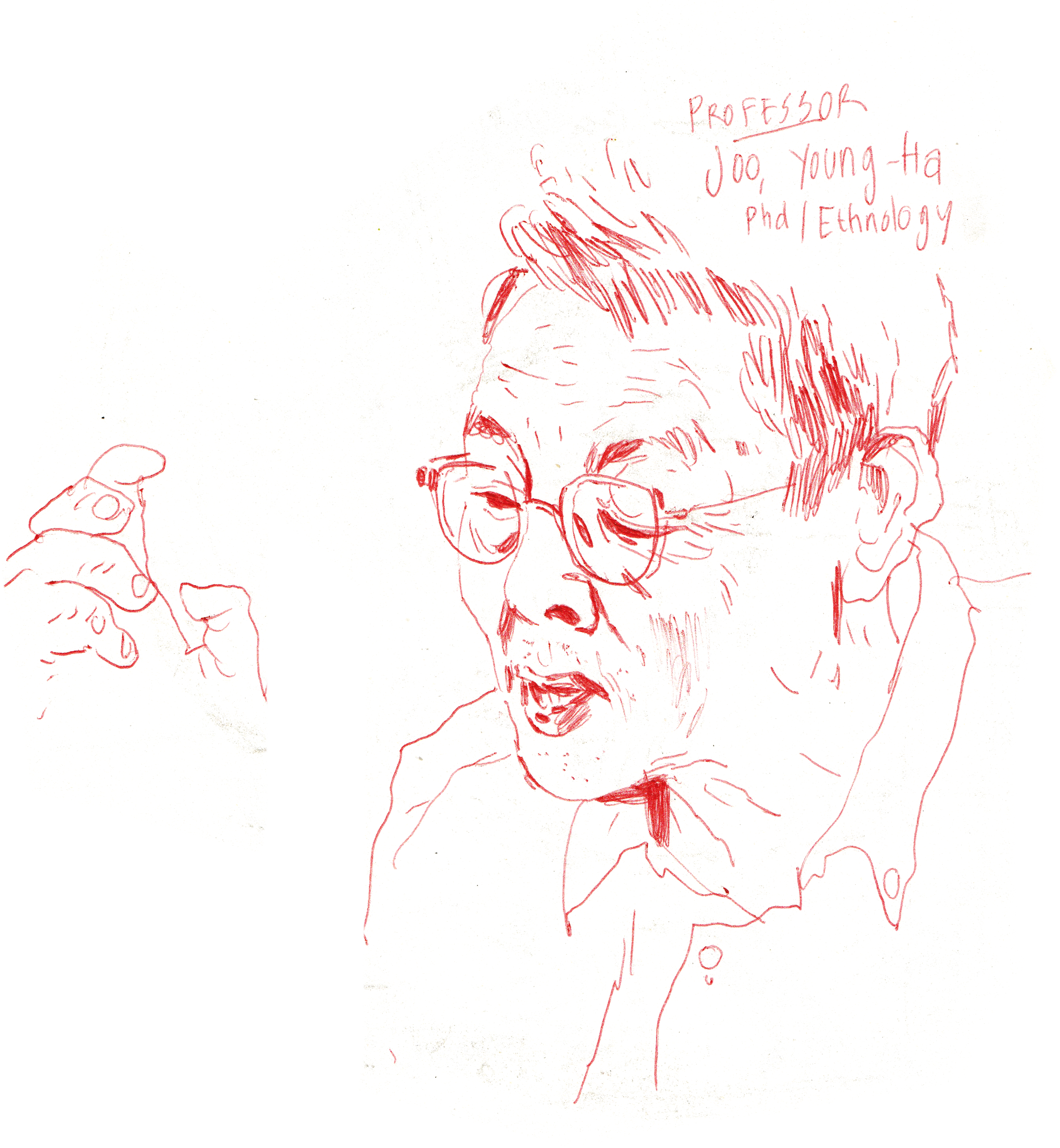
Illustration: Rasmus Meisler
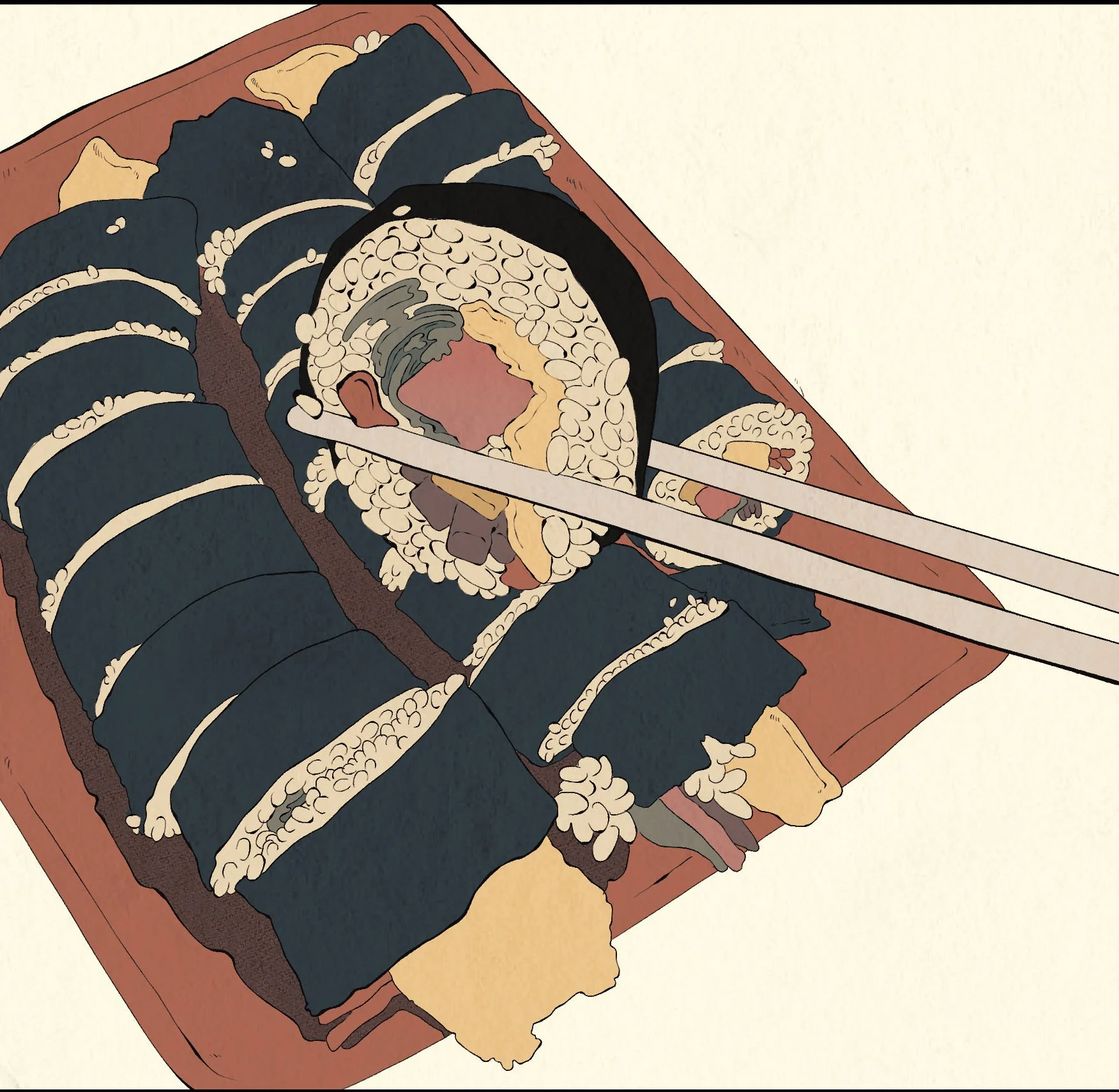
In July 2022, Extraordinary Attorney Woo premiered on Netflix and became, for seven weeks in a row, the most-watched non-English-language programme on the platform. The series succeeded in introducing the Korean dish kimbap to a global audience. Specifically, the protagonist Woo Young-woo's father runs a kimbap restaurant, and every morning she sits there eating kimbap. In front of her lie slices about 1–2 cm thick of rice and seaweed rolled with thin strips of ham, egg, carrot, spinach, braised burdock, pickled radish (takuan), crab meat, and fish cake.
Kimbap is a dish in which rice is spread over a sheet of dried seaweed, after which various fillings are laid in a strip and rolled up. The roll is then cut into bite-sized pieces. The main ingredient, seaweed (kim), is dried edible sea algae pressed into sheets about the size of A4 paper. Since the 1970s, most Korean mothers have made kimbap for their children when they were going on a school outing. In the early 1970s, when I was in primary school, there were, however, many children who couldn't afford to bring a kimbap lunch. My own mother made a full five lunchboxes for my teacher and my classmates, even though it cost quite a bit. As a child I thought they were heavy to carry, but the memories of the kimbap we shared on the outings are unforgettable.
Illustrations: Jeon Nak-joo
Illustration: Thit Bitsch
Illustrations: Jeon Nak-joo
Kimbap arose in Korea at the beginning of the 20th century, while the country was under Japanese colonial rule. There are accounts from the 1700s of eating rice rolled in seaweed, but these have no direct connection to modern kimbap. The earliest reliable source is instead a recipe for "kimsambap" on page 5 of the Korean-language newspaper Dong-A Ilbo on 7 March 1930. The author, a teacher at a girls' school in Seoul, recommends the dish as a packed lunch for cherry-blossom picnics in Changgyŏngwŏn (the former royal palace Changgyŏnggung, converted into a park by the Japanese colonial authorities). She refers to the dish as norimaki-sushi in Japanese, and notes that Japanese seaweed is better than Korean — and that one should therefore use two layers of Korean seaweed.
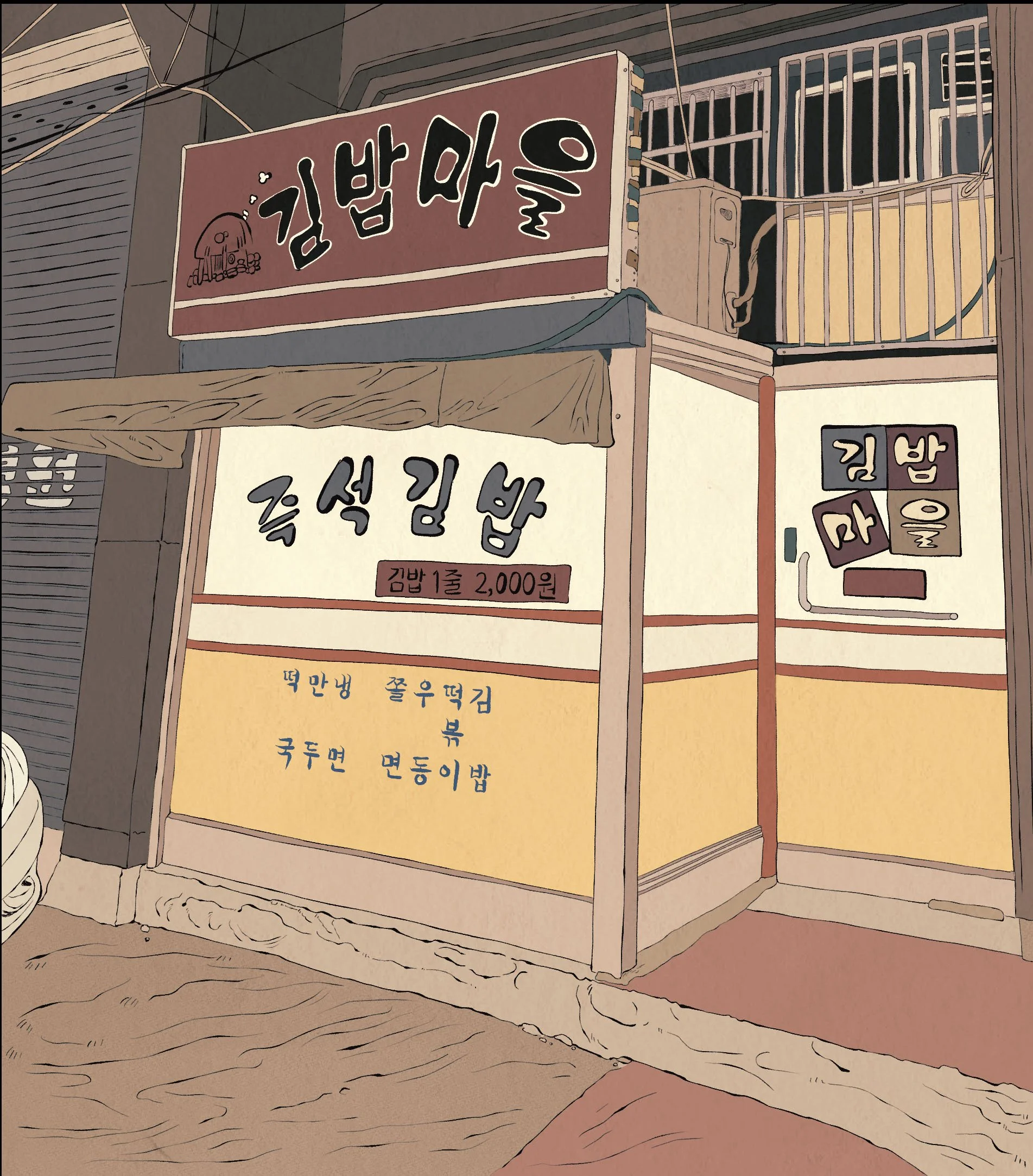
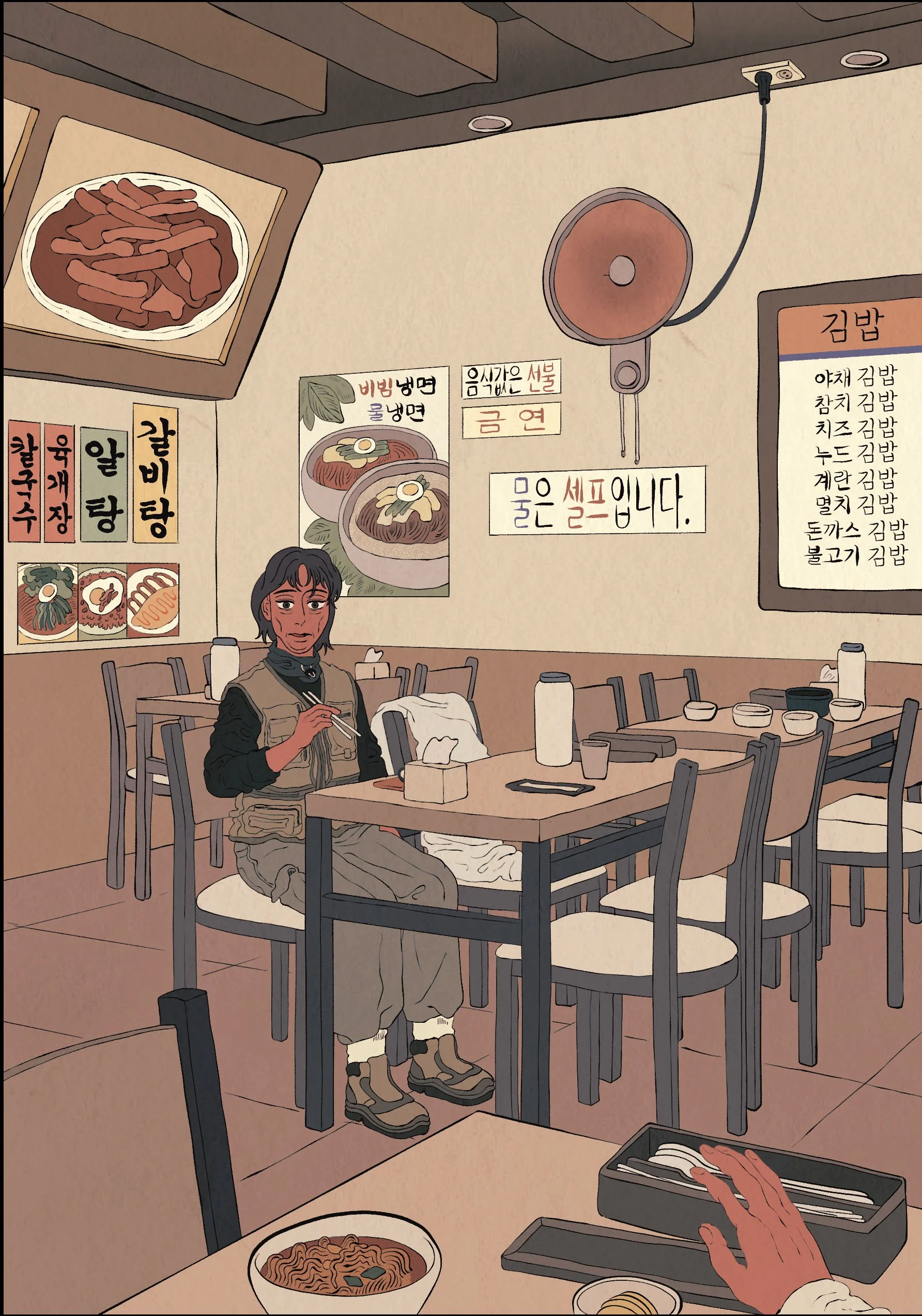
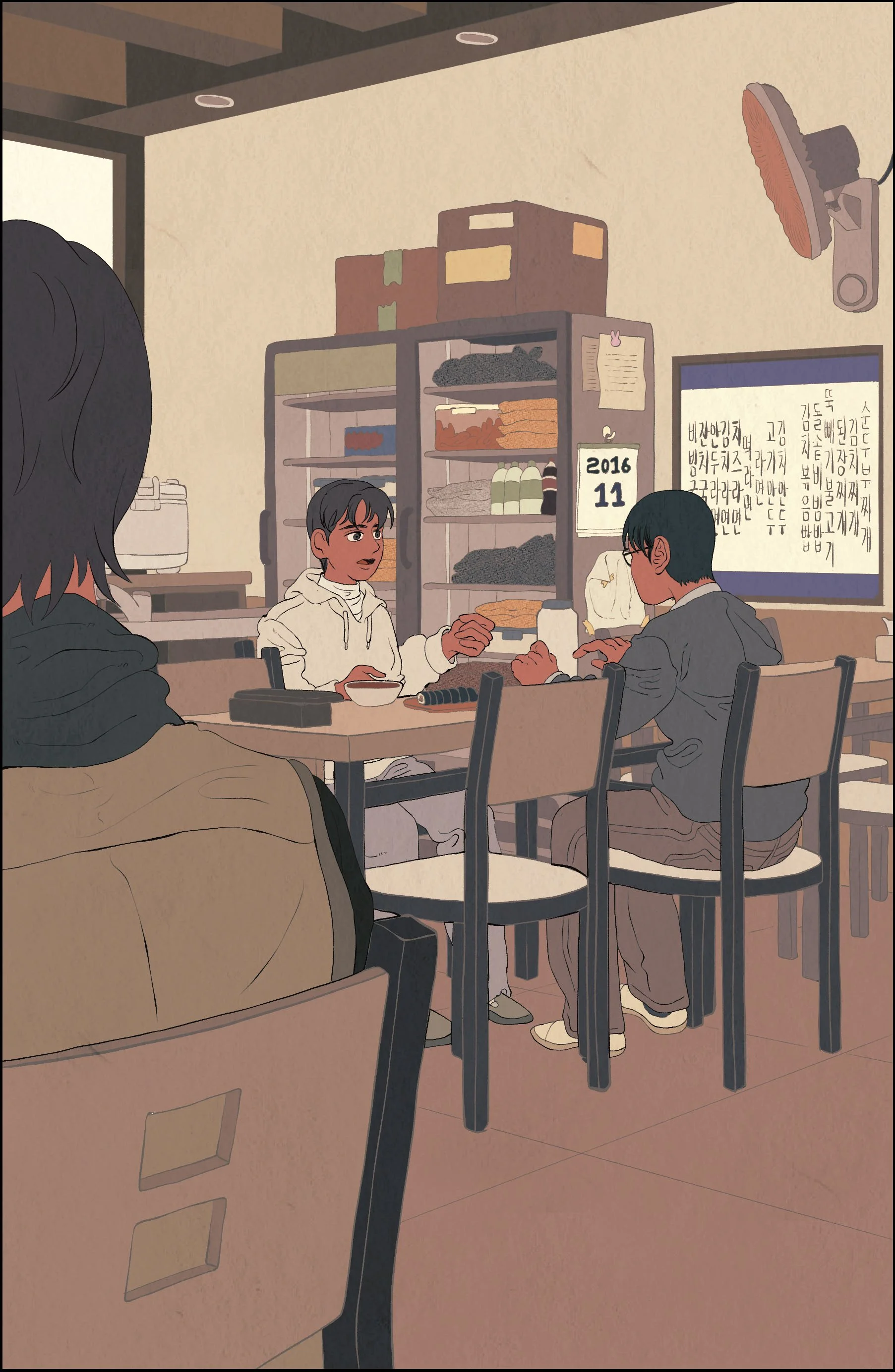
Up until the 1960s, most Korean seaweed was exported to Japan. When production rose in the 1970s, domestic consumption grew, and kim (seaweed) and kimbap became common on Korean dinner tables. In this period, kimbap developed into a distinct Korean dish, different from norimaki-sushi. The filling in kimbap consists of cooked and seasoned ingredients, in contrast to the raw filling in norimaki-sushi. From the mid-1980s, when over 80% of Koreans lived in the cities, specialized kimbap restaurants began to appear at transport hubs. For 'salarymen,' kimbap became a quick, cheap, and practical meal — and the recipe developed in many directions.
Illustrations: Jeon Nak-joo
Since the 2000s, more than 50 new variants have emerged: among them are tuna kimbap with canned tuna and mayonnaise, cheese kimbap with sliced cheese or mozzarella, bulgogi kimbap (grilled-meat kimbap), tonkatsu kimbap (pork-cutlet kimbap), and many more. Kimbap, which includes rice and accompaniments, is a compressed version of the Korean favourite "rice and side dishes," and is a quick and convenient fast food. It's an unfortunate historical fact, but without the experiences of Japanese colonial rule, today's kimbap might not exist.
Another dish with roots in the colonial era is japchae: a dish of glass noodles made from sweet-potato starch, stir-fried with vegetables and other ingredients and seasoned with soy and sesame oil. The New York Times wrote on 30 May 1980:
”The Korean dinner usually requires japchae to be complete. This stir-fried combination of vegetables and vermicelli that includes several kinds of mushrooms and paper-thin slivers of what seemed to be beef, was so elementally satisfying it might well be considered Korean soul food.“ And it's true: japchae belongs on the vast majority of festive tables.
Japchae appears in a Korean cookbook from the 17th century. This early dish is made by cutting various vegetables, mushrooms, and meat into pieces about 2 mm in diameter and 10 cm in length, placing them in a bowl, and mixing them with a seasoning made from pepper, ginger, meat juices, flour, soy sauce, and sesame oil. This japchae recipe does not, however, contain cellophane noodles made from sweet-potato starch. In Korean, cellophane noodles are called dangmyeon (glass noodles), a type of noodle that originates from China.
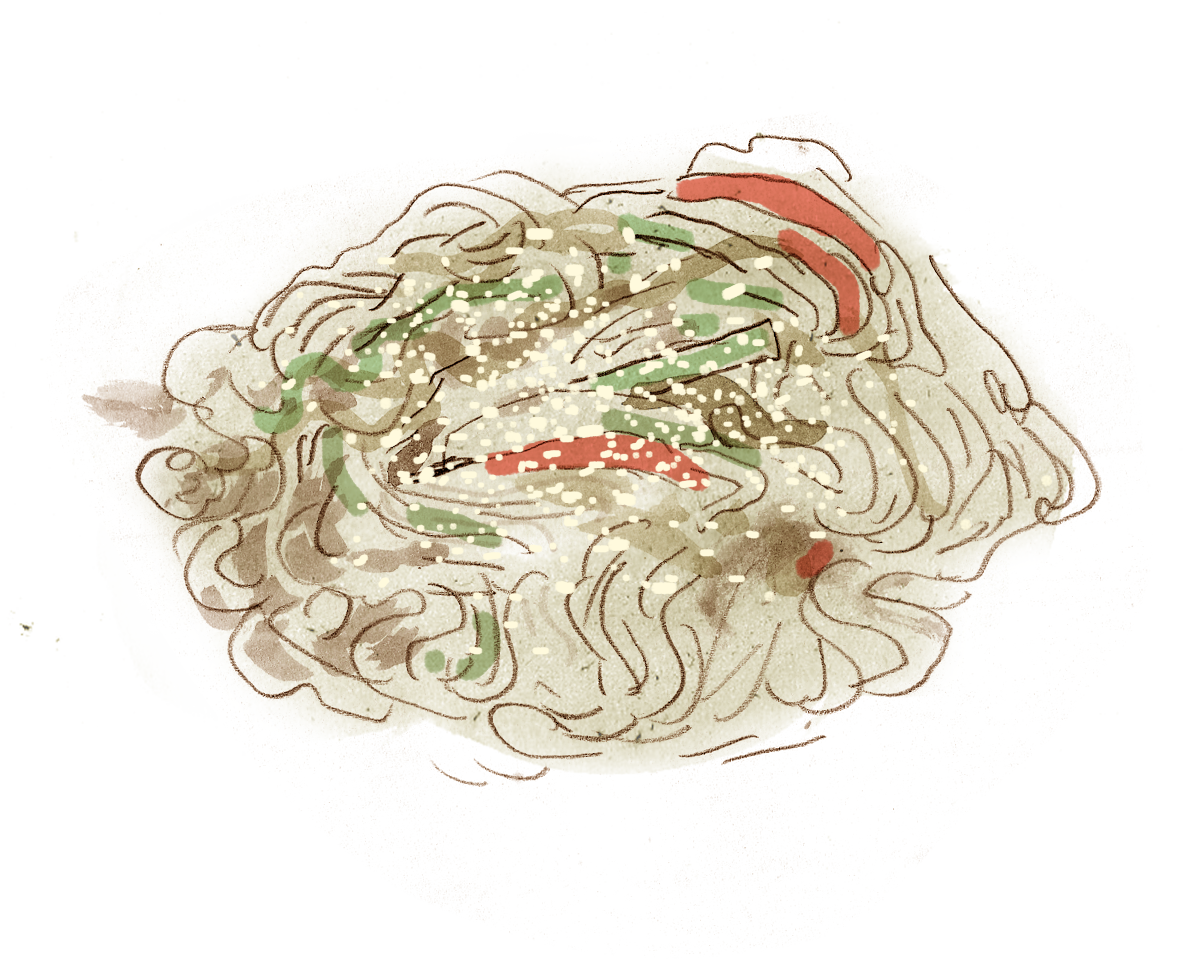
Illustration: Rasmus Meisler
Dangmyeon was brought here by Chinese immigrants who immigrated to Incheon, a coastal city west of Seoul, when it opened its doors to foreign trade in 1883.
In the 1920s there were over 200 Chinese restaurants in Seoul. The dish chǎoròusī (stir-fried shredded pork with glass noodles) was popular among Koreans, who began to create a Korean version at home — the forerunner of modern japchae. The japchae recipe found on page 5 of the Dong-A Ilbo edition of 6 March 1930 contained bellflower root, water dropwort, pork, shiitake mushrooms, wood-ear mushrooms, and glass noodles. It says that one should cut these ingredients into long pieces, fry them individually in cooking oil, and then mix them in a bowl. It also says to use Japanese soy sauce as seasoning.
In July 1937, when the Second Sino-Japanese War broke out, triggering Japan's invasion of northeastern China, many Chinese residents in Seoul returned to their home towns. About 80% of the Chinese restaurants in Seoul closed. As a result, Korean households began to make japchae from scratch. This process gave rise to the Korean version of japchae, which, unlike chǎoròusī (fried in cooking oil), was mixed with Japanese soy sauce and sesame oil. Japchae is therefore a co-creation of Koreans, Chinese, and Japanese who lived in the Japanese colony on the Korean peninsula in the first half of the 20th century.
Along with japchae, noodles are a favourite Korean dish on festive occasions. The main ingredient in noodles is grain-based flour. Although it varies a little from country to country, wheat flour is the most common. Wheat flour contains gluten, a protein that eases kneading. This protein is insoluble in water, so when water is added to the flour and it's kneaded, a membrane forms that gives the dish its shape. Until the first half of the 20th century, Koreans enjoyed buckwheat noodles made from buckwheat flour. This was because winter wheat, sown in winter and harvested before the rainy season, was grown only in small quantities in some areas of the Korean peninsula.
In August 1945, with Japan's surrender, World War II ended. The Korean peninsula was governed by a Soviet military government in the north and an American military government in the south. "The Cold War" unfolded on the peninsula. To strengthen its Cold War umbrella, the USA reinforced its dominance by supplying resources, including surplus agricultural products, to Japan, Taiwan, India, and South Korea. Among the agricultural products that the American government supplied free of charge to the South Korean government was wheat.
Illustrationer: Jeon Nak-joo
The Park Chung-hee government, which took power through a military coup in 1961, exploited the wheat supplied by the USA for political and economic purposes. It mandated that rice could only be used for cooked rice, and forced the production of makgeolli, cheongju, soju (ed.: three types of alcohol), and tteokbokki (rice cakes) to be made with American flour or imported grain. This heavily controlled "flour campaign" led, from the mid-1980s, to a rise in Korean flour-based food culture.
Illustration: Thit Bitsch
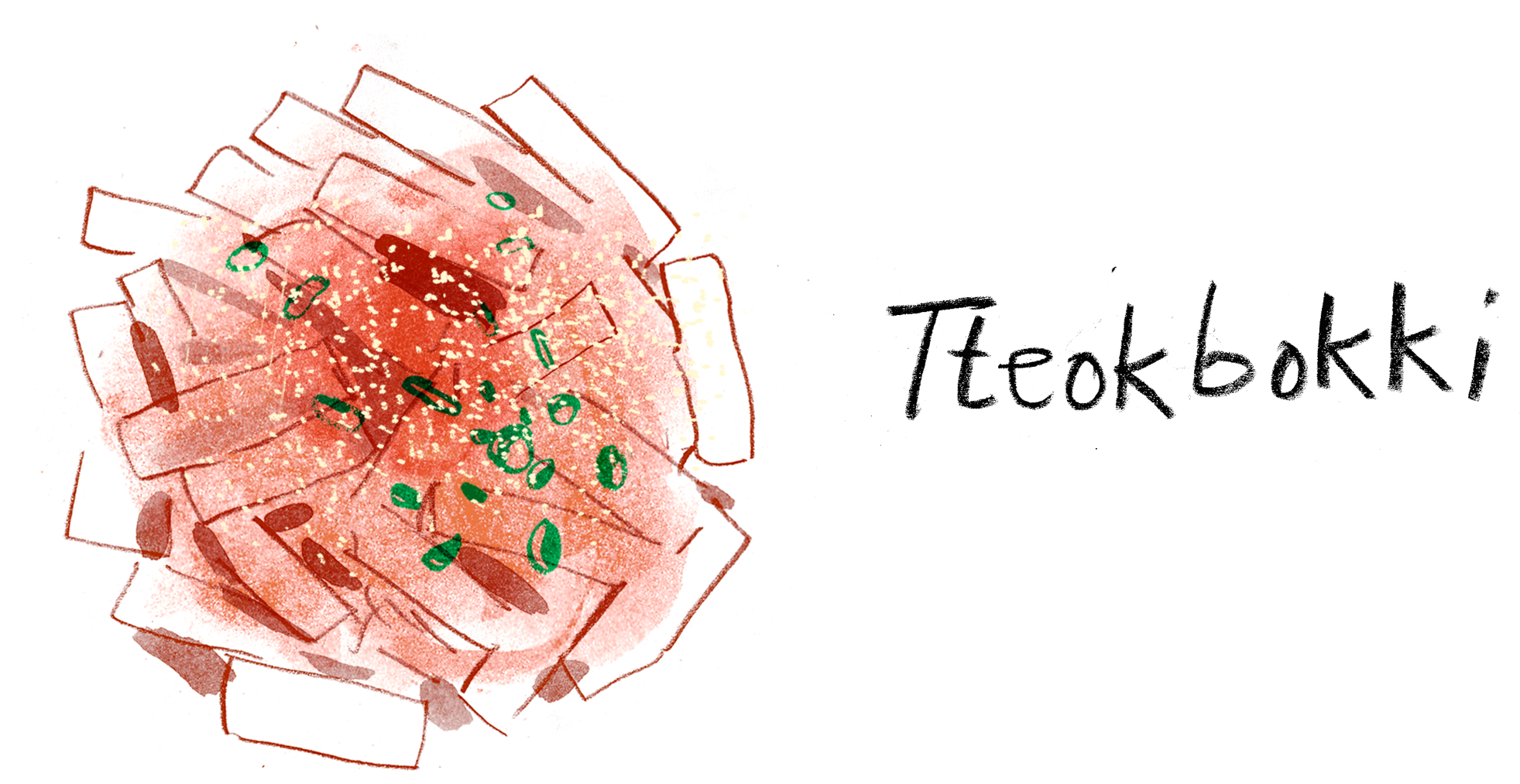
Illustration: Rasmus Meisler
Korean instant noodles, which featured in the original American Netflix animated film K-Pop Demon Hunters, released on 20 June 2025, are a typical Cold War dish made with wheat supplied by the USA. Instant ramen was first developed in Japan in 1958. In 1962, Kiyozumi Okui (1919–1973), a representative of Myojo Foods Co., a Japanese instant-ramen company, believed that Japan's rapid economic recovery after its defeat was due to the country's role as a producer of supplies for the American military during the Korean War. He therefore provided financial and technical support to the Korean company Samyang Foods.
In September 1963, Samyang Foods launched Korea's first instant ramen, with chicken broth. In 1965, Nongshim launched Beef Ramen with beef broth, which gave instant ramen the status of Korean soul food. Instant-ramen companies dried and blended Korean favourites like chili, garlic, and onion into the soup broth. In the 1970s and 1980s, Korean food companies, inspired by Koreans' favourite soups, created over 50 variants of instant ramen.
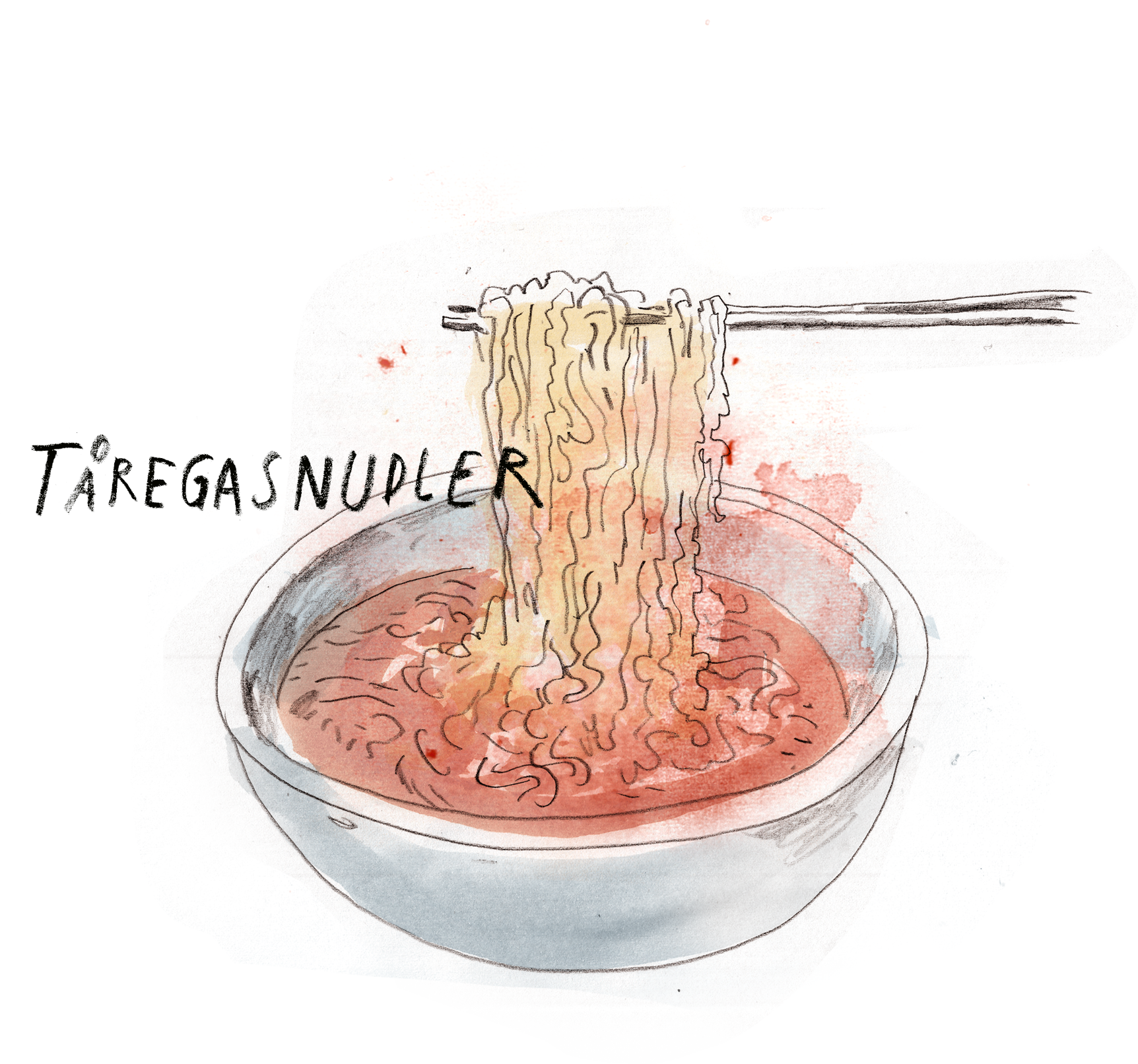
Illustration: Rasmus Meisler
While the Japanese prioritize the noodles' flavour in instant ramen, Koreans prioritize the flavour of the broth. Driven by the global spicy craze in the 2010s, Korea's spicy, sweet instant-ramen soup has gained global popularity.
From the 1960s to the 1980s, the most popular foreign food in Korea was Chinese. The Korean government's "flour campaign" (ed.: promotion of snacks) led to a shift in style; jajangmyeon (noodles with black bean sauce), served at Chinese restaurants, developed into a Korean dish. In the 1970s, after admission and graduation ceremonies at primary schools, middle schools, high schools, and universities, parents took their children to Chinese restaurants to celebrate with jajangmyeon. Jajangmyeon is a Korean-Chinese dish made by mixing tiánmiànjiàng, a fermented blend of wheat flour and soybeans, with water and starch, wok-fried meat and vegetables, and stirring the seasonings into the noodles.
After the end of the Korean War in 1953, ethnic Chinese in Korea were prevented from returning to their home towns in Shandong Province and were forced to acquire citizenship in Taiwan. Before the rise of globalization in 1992, most foreigners in Korea were ethnic Chinese. From the mid-1980s, as apartment complexes shot up in larger Korean cities, the owners of the Chinese restaurants shifted to being Koreans. This process led Korean-Chinese cuisine to break away from the traditional Chinese food category. If you go to a Koreatown abroad, there's at least one Korean-style Chinese restaurant with a Korean cook, because Koreans prefer Korean-Chinese food over Chinese food.
The fall of the Berlin Wall in 1990 and the dissolution of the Soviet Union in 1991 marked the end of the Cold War and the beginning of the globalization period. By the mid-1990s, South Korea, after rapid economic growth, had become a middle-income country. From this point, most Koreans avoided jobs that rely on cheap labour. Those who filled this void were ethnic Koreans from China, North Korean defectors, and labour migrants from Southeast Asia. Since the 2000s, enclaves of migrant workers have arisen in Seoul, provincial cities, and rural districts. Restaurants serving food for migrant workers have taken root in these areas.
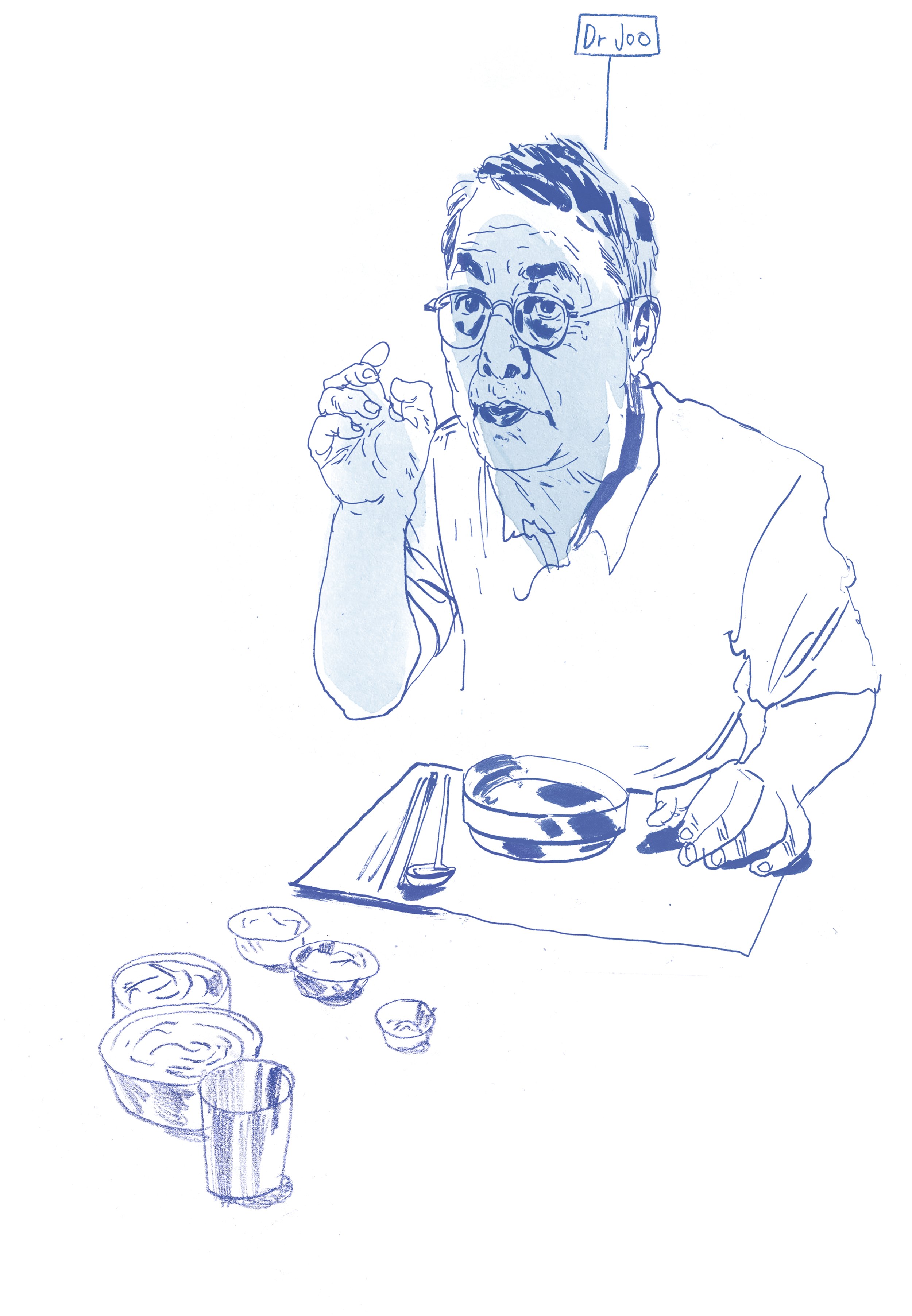
Illustration: Rasmus Meisler
The global popularity that Korean food achieved after 2010 is due partly to the sustained effort since the mid-1960s by Korean chefs and food producers to adapt foreign dishes to Korean taste preferences, and partly to Korean consumers' quick interest in new and unfamiliar processed foods.
During Korea's compressed industrialization in the 1970s, most Korean and foreign foods, from processed foods to street food, followed the path of localization. Korean processed foods and restaurant menus have been well received by foreign visitors to Korea in the era of globalization, when Korean society was open to the outside world. The popularity of Korean processed foods abroad is a product of the sociocultural hybridization that Korean society embraced in a period of high growth and globalization.
In 2000, I published the Korean book "A Hundred Years of Meals: From Western Banquets in the Korean Empire to K-food" (Humanist). It builds on my theory of how Korean food culture from the late 1800s to today has been integrated into global "food regimes." The book's analytical framework consists of six key words, namely: the "opening" of Korea in the Imperial period from 1876; the "colonial period" from 1910 to 1945; the "war," comprising the Pacific War and the Korean War, from 1938 to 1953; the "Cold War," from the end of the Korean War to the 1970s; "compressed growth" in the 1980s and 1990s, when Koreans began to taste the fruits of economic growth; and "globalization," which has been ongoing from the 1990s to today.
A summary of the book in English can be found in: AKS, The Birth of K-Food: History of 20th Century Korean Food, in 2024 Infokorea: An Essential Guide for Educators, AKS Press, 2024, pp. 61–79.